
Biomere’s scientific team have expertise in preclinical oncology models including immune-deficient mouse models (NSG or NCG) engrafted with human PBMCs or CD34+ hematopoietic stem cells combined with human tumor cell line grafts, and cell line-derived xenografts (CDX) models to evaluate efficacy and ADME of novel therapies.
Humanized mouse models bridge the immunological gap between two standard oncology platforms: syngeneic models, which rely on a murine immune system, and PDX models, which offer minimal immune context. Built by engrafting human tumors into immune-deficient mouse strains, such as NSG or NCG, and then reconstituting them with a human immune system via PBMC or CD34+ stem cell humanization, these models let sponsors evaluate novel immuno-oncology therapies in vivo with functional human immune cells. This makes them especially well suited for complex modalities, including antibody-drug conjugates (ADCs), bispecifics, T-cell engagers, and immune checkpoint inhibitors, where a mouse-only immune system simply can’t generate translatable data.
Humanized mouse models answer questions that syngeneic and PDX models can’t reach on their own. They can demonstrate tumor growth inhibition driven specifically by human immune cells, whether in response to monotherapy or combination regimens, and they surface early toxicity signals such as off-tumor effects and cytokine release syndrome (CRS)-like events, giving sponsors a translational readout before a program moves into the clinic.
These models also clarify mechanism of action (MoA), showing not just whether a therapy works but how it engages the human immune system. MoA is tracked through shifts in immune cell populations (via flow cytometry) and changes in the tumor microenvironment (via histopathology and gene expression profiling), giving sponsors a mechanistic picture alongside efficacy data.
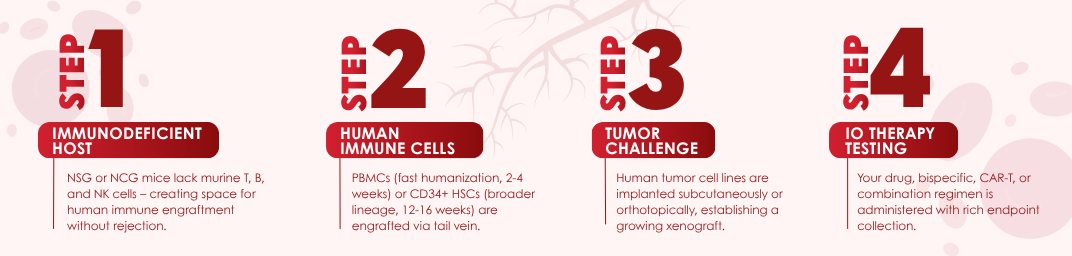
Peripheral blood mononuclear cells deliver rapid engraftment and robust T cell responses, making this model well suited for evaluating immune checkpoint inhibitors, T cell engagers, and bispecifics targeting T cell co-stimulation.
Hematopoietic stem cells generate multilineage human immune development, including T cells, B cells, NK cells, dendritic cells, and myeloid subsets. This supports more complex immune mechanism of action (MoA) studies and longer duration experiments without early GvHD onset.
Key Differences between PBMC and CD34+ stem cell engraftment:
|
PBMCs |
CD34+ Stem Cells |
|
|
Engraftment time |
2-4 weeks |
12-16 weeks |
|
Cell Population |
T-cell dominant |
Multiple lineages |
|
Graft vs Host Disease Window |
3-6 weeks post transplantation |
10-22 weeks post-transplantation |
Biomere has developed expertise in establishing humanized mouse models and evaluating the efficacy and mechanism of action of single or combination therapies. We source established immune deficient models and donor specific PBMCs or CD34+ cells, then perform humanization and tumor cell implantation in-house.
Cell line derived xenograft (CDX) mouse models are foundational tools for evaluating novel cancer therapies. CDX models are established in immune deficient mice that lack T cells, B cells, and NK cells, so the mice cannot mount an immune response against implanted tumor cells. Commercially available tumor cell lines are typically implanted subcutaneously or orthotopically to form tumors. Subcutaneous implantation produces visually measurable tumors under the skin, while orthotopic implantation may require imaging to detect tumor growth. CDX models are cost effective, reproducible, and rapid to establish, making them useful for screening drug candidates for efficacy and ADME characteristics, though they have limited applications in mechanism of action studies.
Biomere has experience establishing CDX models using various cell lines. Once a tumor model is established, the team can perform a comprehensive suite of assays, including:
A humanized mouse model is developed from an immune-deficient mouse that has been transplanted with human immune cells and then engrafted with human tumor cells. . This combination lets researchers study how human immune cells interact with a human tumor in an intact in vivo system, something neither a standard xenograft nor a fully murine model can replicate.
Syngeneic models use a fully murine immune system, and PDX (patient-derived xenograft) models use immune-compromised mice with minimal immune context. Humanized mouse models sit between the two, pairing a human tumor graft with a reconstituted human immune system, which makes them the only one of the three suited to evaluating therapies that modulate immune cell activity.
Biomere builds humanized mouse models using two approaches: PBMC (peripheral blood mononuclear cell) humanization and CD34+ hematopoietic stem cell humanization. Both begin with an immune-deficient NSG or NCG mouse strain, but they differ in engraftment speed, the breadth of immune cell types generated, and how long the model remains usable before graft-versus-host disease (GvHD) sets in.
PBMC humanization engrafts within 2 to 4 weeks and produces a strong, T-cell dominant immune response, making it well suited for faster-turnaround studies. CD34+ humanization takes longer to engraft, typically 12 to 16 weeks, but generates multiple human immune lineages, including T cells, B cells, NK cells, dendritic cells, and myeloid subsets, supporting longer and more comprehensive studies.
Humanized mouse models are well suited to evaluate immune checkpoint inhibitors, antibody-drug conjugates (ADCs), bispecific antibodies, and T-cell engagers, since these therapy classes depend on interaction with a functional human immune system. A syngeneic or standard PDX model cannot generate translatable data for these modalities due to the lack of a functional human immune system.
The timeline depends on the humanization method. PBMC-humanized models are ready for tumor engraftment and dosing within 2 to 4 weeks, with a graft-versus-host disease (GvHD) window of roughly 3 to 6 weeks. CD34+-humanized models take longer to establish, around 12 to 16 weeks, but offer a wider usable window before GvHD onset, typically 10 to 22 weeks.
Yes. Because these models carry a functional human immune system, they can surface early human-specific toxicity signals, including cytokine release syndrome (CRS)-like responses and on-target, off-tumor effects. This gives drug developers a translational safety readout before a therapy moves into clinical development.
Mechanisms of action of specific therapies are measured through specific endpoints such as changes in immune cell populations (via flow cytometry), and changes in the tumor microenvironment (TME), characterized using histopathology and gene expression profiling. Together, these endpoints show not just whether a therapy is working, but how it is engaging the human immune system to do so.
Biomere humanizes NSG and NCG immune-deficient mouse strains, which lack a functional murine immune system and therefore accept both a human tumor graft and human immune cell engraftment without rejection. Both strains are well characterized and widely used in preclinical oncology research.
Biomere offers an end-to-end workflow that includes PBMC and CD34+ humanization capabilities, integrated endpoint analysis including IVIS imaging, flow cytometry, and histopathology, and direct access to project scientists. This combination supports fast and flexible study startup and execution, and closer collaboration than many large CROs offer for translational immuno-oncology programs.
A CDX model is established by implanting a commercially available human tumor cell line into an immune-deficient mouse that lacks T cells, B cells, and NK cells, so the mouse cannot mount an immune response against the graft. This makes CDX models a fast, reproducible way to establish a human tumor for early efficacy and ADME screening.
CDX models use immune-deficient mice with a minimally functional immune system, so they can’t be used to study immune-mediated mechanisms of action. Humanized mouse models add back a human immune system through PBMC or CD34+ humanization, which enables evaluation of therapies that depend on immune cell activity, such as checkpoint inhibitors and T-cell engagers.
CDX models are cost-effective, reproducible, and quick to establish, making them well suited for screening drug candidates for efficacy and ADME (absorption, distribution, metabolism, and excretion) characteristics early in development. Because they lack a functional immune system, they have limited application in mechanism of action studies involving immune-mediated therapies.
Subcutaneous implantation places tumor cells under the skin, producing visually measurable tumors that can be tracked with calipers. Orthotopic implantation places tumor cells in their tissue of origin, more closely mimicking the tumor’s native environment, but it typically requires imaging, such as IVIS, to detect and monitor tumor growth.
Biomere’s CDX studies include tumor growth monitoring via caliper measurement or IVIS-based imaging, histopathological analysis of tumor tissue, flow cytometry and cell sorting of immune cells and dissociated tumor tissue, biodistribution and pharmacokinetic (PK) analysis, and clinical chemistry panels to assess biomarkers.
The choice depends on your therapy’s mechanism. CDX models are the faster, lower-cost option for early efficacy and ADME screening of any oncology therapy. Humanized mouse models are necessary when a therapy’s activity depends on the human immune system, such as with checkpoint inhibitors, ADCs, bispecifics, or T-cell engagers.

