
Organ-Chip Services

Biomere has partnered with Emulate to offer early toxicology CRO services using the Zoe Organ-Chip system, a NAMs platform nearing full qualification as an FDA Drug Development Tool (DDT). The platform allows toxicity assessment of novel therapies before moving to time-consuming and costly in vivo studies. It also supports the 3Rs, with the potential to reduce and refine animal use.

Cell-based platform to Evaluate Toxicity

The Organ-Chip platform supports the culture of multiple cell types from specific organs, including the liver, kidney, lungs and brain. Cells are cultured in a microfluidics-controlled system that flows media across two channels separated by a membrane, allowing different cell types to be cultured in each channel and interact with each other.

In the Liver-Chip primary human hepatocytes are cultured on the top channel, with non-parenchymal cells (Kupffer cells, stellate cells, and liver sinusoidal endothelial cells, or LSECs) on the bottom. This combination of tissue-specific cells and continuous media flow mimics the in vivo state, supporting physiologically relevant responses to therapies.

Biomere offers preclinical drug discovery services using the Organ-Chip system. The first validated application is evaluation of drug-induced liver injury (DILI), a key component of drug safety studies. Subsequent services will include kidney toxicity assessment using the Kidney-Chip and neurotoxicity assessment using the Brain-Chip.

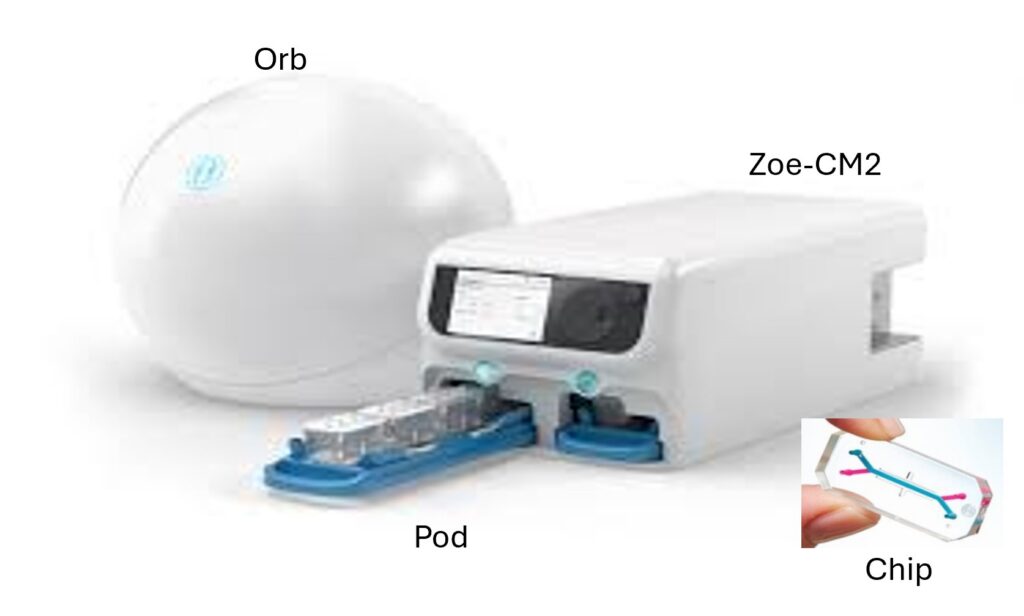
Figure 1: Emulate’s Organ-Chip system includes the Orb, the Zoe-CM2, and pods that hold the chips. Each Zoe culture module holds 12 chips (one per pod), and the Orb module connects to lab equipment to monitor gas, power, and other parameters.
On This Page

Advanced Animal Cohort Management

The Organ-Chip platform supports the culture of multiple cell types from specific organs, including the liver, kidney, lungs and brain. Cells are cultured in a microfluidics-controlled system that flows media across two channels separated by a membrane, allowing different cell types to be cultured in each channel and interact with each other.
 
In the Liver-Chip primary human hepatocytes are cultured on the top channel, with non-parenchymal cells (Kupffer cells, stellate cells, and liver sinusoidal endothelial cells, or LSECs) on the bottom. This combination of tissue-specific cells and continuous media flow mimics the in vivo state, supporting physiologically relevant responses to therapies.
 
Biomere offers preclinical drug discovery services using the Organ-Chip system. The first validated application is evaluation of drug-induced liver injury (DILI), a key component of drug safety studies. Subsequent services will include kidney toxicity assessment using the Kidney-Chip and neurotoxicity assessment using the Brain-Chip.
Figure 1: Emulate's Organ-Chip system includes the Orb, the Zoe-CM2, and pods that hold the chips. Each Zoe culture module holds 12 chips (one per pod), and the Orb module connects to lab equipment to monitor gas, power, and other parameters.

The primary endpoints for the Organ-Chip system include:

  • Cell morphology and viability
  • Liver enzyme levels (ALT and AST) using ELISA kits
  • Gene expression profiling using qPCR
  • LC-MS analysis of drug metabolites and biomarkers

The Biomere team is excited to collaborate with drug developers to evaluate new Organ-Chip models and services.

Study Designs to Assess Liver Toxicity on the Organ-Chip platform

Biomere scientists have performed pilot studies to evaluate the Organ-Chip platform using available medications reported to cause liver injury clinically.

LPS-Induced Toxicity:

  • Chips were seeded with primary hepatocytes in the top channels and non-parenchymal cells (Kupffer, stellate, and LSECs) in the bottom channels.
  • Cells were cultured for 10 days prior to stimulation with buffer, LPS, mIL-7, anti-human IFN-gamma, or client-provided novel therapies.
  • Supernatants were collected on days 0, 2, 7, and 14 and assayed for liver enzymes (ALT, AST) and albumin, known markers of injury. RNA was purified from control and LPS-treated cell lysates for downstream qPCR analysis.

Acetaminophen Toxicity:

  • Chips were seeded with primary hepatocytes in the top channels and non-parenchymal cells (Kupffer, stellate, and LSECs) in the bottom channels.
  • Cells were cultured for 7 days with acetaminophen at three concentrations.
  • Supernatants were collected on days 0, 1, 2, 3, 4, 5, and 7 and assayed for liver enzymes (ALT, AST) and albumin, known markers of injury.
  • Chips were imaged daily for morphological analysis.

Clozapine-Induced Toxicity:

  • Cells were cultured for 7 days with clozapine at 300x Cmax concentration.
  • Supernatants were collected on days 0, 1, 2, 3, 4, and 7 and assayed for liver enzymes (ALT, AST) and albumin, known markers of injury.
  • Chips were imaged daily for morphological analysis.

These examples highlight the protocols and key endpoints used to measure liver toxicity induced by known or novel therapies in a physiologically relevant human Organ-Chip system.


Discuss your study needs