Models and Resources for CNS, Oncology and Metabolic Disease
Biomere’s scientists work across multiple therapeutic areas, including CNS diseases, oncology, and metabolic diseases. Our team has developed deep expertise in dosing routes for both large and small animal models, as well as extensive experience with complex rodent models for oncology and metabolic disease studies.
A critical consideration in the preclinical evaluation of CNS-targeted therapies is the choice of dosing route. Systemic dosing often results in poor CNS distribution due to the blood-brain barrier (BBB), whereas tissue-specific dosing can significantly improve bioavailability in CNS tissues and cerebrospinal fluid (CSF).
The most commonly used CNS dosing routes in preclinical animal models, including rodents, rabbits, and non-human primates (NHPs), are:
IT (Intrathecal): Injection into the spinal canal or subarachnoid space
ICM (Intra Cisterna Magna)
ICV (Intra Cerebral Ventricular)
Intranasal: Used primarily in NHPs
Once a therapeutic is administered directly into CNS tissues, CSF sampling and analysis is the standard method for assessing drug exposure and biomarker levels. Serial CSF collection is facilitated by the placement of chronic indwelling ports, which enable repeated sampling in conscious animals and eliminate the need for multiple sedation events. Properly placed CSF ports also minimize sample contamination with red blood cells. Beyond chronic porting, Biomere’s expertise extends to direct-stick techniques targeting the lumbar and cisternal intrathecal space, for both IT dosing and CSF collection.
Biomere’s small animal scientists have deep expertise in rodent tumor models for evaluating novel antitumor therapies, including CAR-T, ADCs, monoclonal antibodies (mAbs), small molecules, and gene therapies. Once a tumor model is established, our team can perform a comprehensive suite of assays, including:
Tumor growth monitoring via caliper measurement or IVIS-based imaging
Biodistribution and PK analysis of investigational therapies
Immune response assessment using cytokine panels and serum biomarkers
Histopathology of tumor tissues
Flow cytometry of tumor tissues and immune cells
The team has experience with CDX (cell-derived xenograft), syngeneic, and humanized mouse models (e.g., NSG) to support evaluation of complex antitumor therapies.
Biomere has experience with a broad range of rodent models for metabolic diseases, including obesity, type I and type II diabetes, hyperlipidemia, and hypercholesterolemia. Our team works with both induced and genetically modified models, including:
Streptozotocin (STZ): A chemically induced model in which STZ destroys insulin-producing pancreatic beta-cells, mimicking type I diabetes
ob/ob and db/db mice: Genetically engineered to be leptin-deficient and leptin receptor-deficient, respectively, modeling type II diabetes
ZDF rats: Carrying a leptin receptor mutation (fa/fa) that drives spontaneous development of insulin resistance, hyperlipidemia, and obesity
Relevant endpoints for metabolic disease models include body weight, blood glucose, insulin, and hemoglobin A1c (HbA1c). Biomere also offers metabolic cages for urine and fecal collection to support downstream analysis. Additional endpoints encompass cytokine levels and clinical chemistry markers, including HDL, LDL, total cholesterol, triglycerides, and liver enzymes. In partnership with specialist providers, Biomere offers comprehensive histology services including immunohistochemistry (IHC) and singleplex and multiplex immunofluorescence (IF).
Figure 1: Changes in blood glucose levels of mice treated with Streptozotocin (STZ) over 9 days.
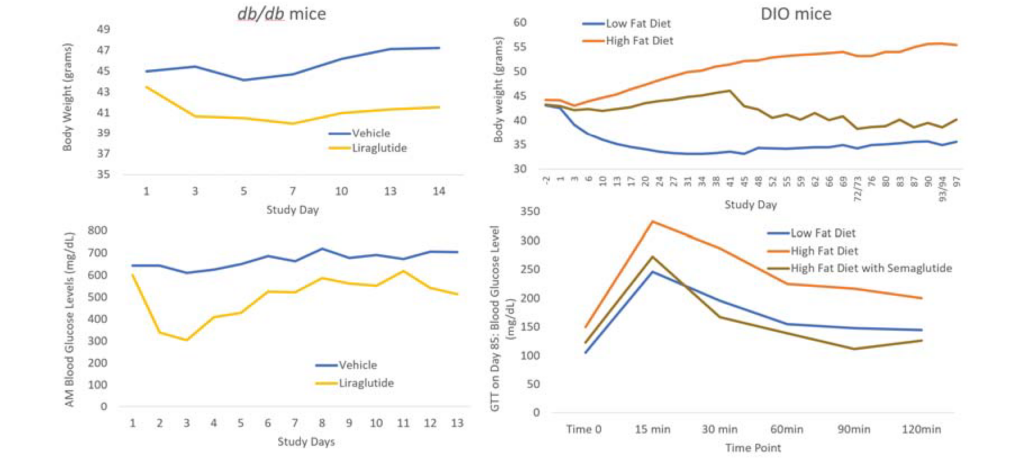
Figure 2: Changes in body weight and blood glucose in db/db mice treated with either vehicle or the GLP-1 receptor agonist liraglutide (left panels). Changes in body weight and blood glucose in DIO mice fed with either low fat or high fat diet -/+ semaglutide (right panels)
Figure 3: Changes in body weight and blood glucose levels in ZDF rats treated with either vehicle or pioglitazone, an approved therapy to manage type II diabetes.