Nonhuman Primate Models for Neurodegenerative Diseases
Neurodegenerative diseases encompass several disorders that are typically associated with the death of specific neuron types resulting in loss of motor, cognitive and other abilities,

Biomere offers rapid, quality-controlled pharmacokinetic (PK) and pharmacodynamic (PD) studies to characterize different therapeutic modalities. We offer multiple species for PK/PD studies, including mice, rats, rabbits and primates. Our team has successfully completed non-GLP PK/PD studies to evaluate multiple modalities, including antibodies, oligos, gene therapies, ocular therapies etc.
Biomere offers comprehensive PK/PD analysis in rodent models (mice and rats) using multiple dosing methods. The most common route of administration is intravenous through the tail vein, but the Biomere team has expertise in retro-orbital IV injection, oral gavage, subcutaneous, intraperitoneal, intramuscular and other routes of administration. Neonate animals can also be dosed using subcutaneous, intraperitoneal and surgical ICV methods. Dosed animals are monitored in-life for body weight changes and clinical observations, which includes blood sample collections. Terminal collections include tissues and blood samples that are shipped to the client or third-party for downstream analysis. Biomere is actively growing the laboratory science portfolio to offer more endpoint assays to clients and partners, with platform providers to offer histopathology and mass spectrometry (LC-MS) analyses.

Our NHP program includes a large colony of naïve and non-naïve cynomolgus macaques supporting PK/PD studies. We offer specialty surgical services, including CSF porting and advanced biopsy techniques, which include liver (open surgery & percutaneous), spleen, muscle and skin. The team offers options for data analysis, such as rapid data sharing, as well as full reporting capabilities. The team has expertise in multiple routes of administration, including:
Different tissues and blood samples can be collected at client-specified timepoints for analysis. Bone marrow aspirates can be collected, as well. At the end of the study, terminal collections of blood and client specified tissue samples.
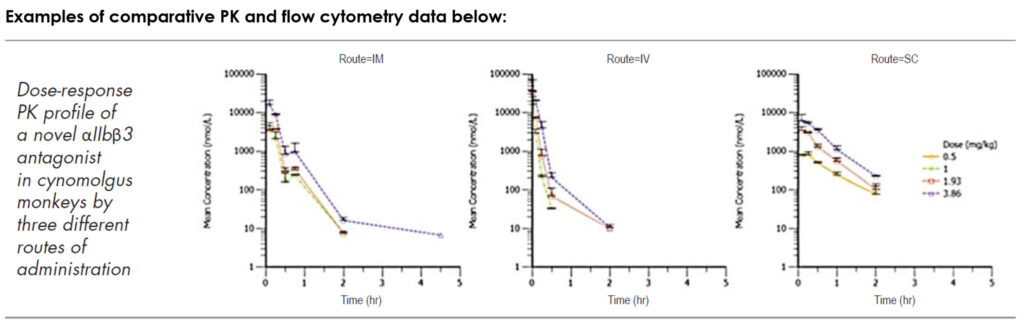
Blood, bone marrow and tissue samples can be collected during or at the end of studies. The samples are frozen or fixed prior to shipment to clients or third-party platform contractors, or can be analyzed at Biomere. Most tissues can be collected, including liver, lymph nodes, skin punches, ocular tissues etc. Blood samples can be analyzed in-house or in collaboration with partners to assess cytokine expression, immunoglobulin (Ig) levels and profiling immune cells using flow cytometry. Additional assays include histopathology, coagulation, chemistry panels and urinalysis. We are expanding our portfolio of laboratory sciences assays to include additional molecular assays. Biomere offers IVIS bioluminescent and fluorescent imaging and ocular-specific OCT and fundus imaging.
Neurodegenerative diseases encompass several disorders that are typically associated with the death of specific neuron types resulting in loss of motor, cognitive and other abilities,
Nonhuman primates (NHPs) are highly translational models in drug development and are widely used in preclinical efficacy and safety studies1. Due to genotype similarities with
The drug development process has several critical milestones. One of the milestones is pharmacokinetics (PK) studies, which is the study of how a given drug
CNS (central nervous system) tumors are primarily located in the brain with some tumors in the spinal cord. CNS tumors can be of various types
Temporal lobe epilepsy (TLE) is a chronic brain disorder where recurrent seizures occur in the temporal lobe. TLE can cause psychological issues, loss of short-term
ADME — absorption, distribution, metabolism, and excretion — is pharmacokinetics (PK). These four processes describe what the body does to a therapy over time and are the core readouts of a PK study. Absorption moves the drug from the dosing site into circulation; distribution tracks where it travels and accumulates (often in the liver); metabolism is enzymatic breakdown (for example, CYP450 for small molecules, lysosomal/proteolytic processing for biologics); and excretion clears drug and metabolites via urine, feces, bile, or exhalation.
Pharmacokinetics (PK) is what the body does to a drug — its absorption, distribution, metabolism, and excretion. Pharmacodynamics (PD) is what the drug does to the body — its target engagement, therapeutic effect and mechanism of action. The simplest way to remember the difference is that PK is the body acting on the drug and PD is the drug acting on the body. PD is typically measured using disease specific biomarkers (e.g., HER2 in certain breast cancers) that change in response to a therapy, and metrics like EC50 which is the concentration that produces half of a drug’s maximum effect.
A PK/PD study measures how a drug moves through the body (PK) and the biological response it produces (PD). Animals are dosed systemically or in a specific tissue type, blood and tissue are collected at defined timepoints, and drug concentrations and effect markers are quantified. The resulting data guide dosing, routes of administration, dosing frequency and monitoring that are critical requirements for preclinical pharmacology, toxicology and eventually clinical trials.
The core PK parameters are Cmax (peak concentration), Tmax (time to peak), AUC (total exposure), half-life (t½), clearance (CL), volume of distribution (Vd), and bioavailability (F). Together they describe the amount of drug that reaches systemic circulation and the persistence of the drug and major metabolites.
EC50 is the drug concentration that produces 50% of its maximum biological effect, making it a standard measure of potency in PD — a lower EC50 means a more potent drug. PD effects are tracked using biomarkers relevant to the target tissue and therapeutic mechanism of action.
Common preclinical PK/PD models include mice, rats, rabbits, swine (e.g. mini-pigs and nano-pigs) and non-human primates such as cynomolgus macaques. Species choice depends on the modality and translational relevance. Typically, rodent models are used for early screening and optimization studies while large animal models are used for lead candidate optimization studies that can include specialty dosing methods. Primate models are often the most translationally relevant species for complex biologics and viral or nonviral gene therapies.
GLP or Good Laboratory Practice refer to strigent quality systems and standards that are designed to ensure high quality non-clinical data (typically safety assessment studies) that are submitted to regulatory agencies such as the FDA and EMA. Non-GLP PK/PD studies support early discovery and candidate selection, prioritizing speed and flexibility, while GLP studies follow strict regulatory standards required for IND-enabling submissions. Non-GLP data often inform the design of GLP programs.
One of the key components of PK studies is identifying the optimal route of therapeutic administration. Routes of administration can be broadly divided into systemic and tissue specific. Systemic routes include intravenous, subcutaneous, intramuscular, oral gavage, and intraperitoneal. Some examples of tissue-specific routes include intravitreal, subretinal, retro-orbital and subconjunctival in the eye or intrathecal, intracerebroventricular (ICV), intra cisterna magna or intranasa for the CNS. Preclinical routes of administration typically mirror the intended clinical delivery.
PK/PD studies usually collect serial blood samples for plasma drug quantification (often by LC-MS) plus terminal tissues to analyze therapeutic accumulation, distribution and early toxicology. The range of endpoint assays can vary depending on the therapy but typical methods include flow cytometry, quantitative PCR and transciptomics to assess mRNA expression, Western blotting to assess protein expression, sandwich ELISA based assays to measure cytokines or serum biomarkers, histopathology analysis of tissues, clinical chemistry parameters such as blood cell populations (CBC) and kidney function panels and noninvasive imaging such as IVIS and MRI.

